Wednesday, November 20, 2013

2013 Recycling Challenge

The results of the fourth annual Riverbend Fiber Arts Guild Challenge were displayed at the November guild meeting. With the theme of "Recycle, Reuse and Repurpose," five clever and crafty guild members repurposed, recycled and created their entries from various discarded items that might otherwise have been destined for the trash bin.

A Challenge requirement was that entries were comprised of at least 80% recycled materials. Photos of these materials—in their original state—were shown alongside the final reincarnations. Through a vote by those in attendance, ribbons were awarded in two categories, "Wearable or Accessory" and "Household Item" along with a Viewer's Choice award.
"Kiss the Cook" apron made from a ink-stained man's shirt.
Ribbon winner in the Wearable/Accessory category.
Left: a dog jacket made from a pair of long leather gloves. Viewer's Choice ribbon.
Right: vase made from old license plate and computer components.
Ribbon winner in the Household Item category.
Old blue jeans and embellished scarf were converted into a purse. 
Painted and embellished dryer sheets made into a prayer flag.
The first annual Riverbend Fiber Arts Guild Challenge event was held in 2010 with a wearable art exhibit entitled, "The Power of the Pocket." Several of these textile art garments went on to a special exhibit in Tennessee Presents Textiles, a regional fiber arts runway show.

That premiere event was followed by the "Fiber and Caffeine get me going..." Guild Challenge in 2011 with an exhibit of fiber art tote bags inspired by a favorite coffee mug.

The 2012 Challenge, "Animal, Vegetable or Mineral?" was an exhibit of 3-dimensional fiber art pieces inspired by something in nature.

Wednesday, October 9, 2013

Weaving in the Navajo spirit

The Riverbend Fiber Arts Guild had an informative program on Navajo weaving at the October guild meeting. Mary Wells, who was inspired to learn weaving through her exposure to Navajo woven textiles, shared her personal experience from a two-week healthcare tour of a Navajo community in the southwest.
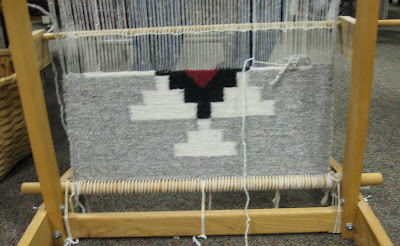
Navajo weaving on an upright loom.
Navajo weaving is a tapestry weaving technique that uses a vertical loom and produces fixed-width textiles. The textiles are very finely woven with coarse, but sturdy yarn. Twined selvedges [multiple heavier warp yarns that are twisted together] are incorporated for strength and durability.
Mary at her vertical Navajo-style loom.

"The Navajo tribes were originally nomadic and followed the grazing paths of the Churro sheep," said Mary as she talked about the history of the Navajo people. The wool from these long-haired animals was spun into the yarn for weaving. The colors used to dye the yarn came from local plants, minerals and insects, so a community's handiwork could often be identified by the color palettes of the textiles. Uncommon yarn colors found in some weavings were likely obtained from traders and missionaries. "The appearance of these colors can be a source for dating the textiles," Mary added. The patterns and design motifs that were woven into the textiles were also unique to each Navajo community.

Mary described the Navajo culture as reverent, respectful and environmentally conscious. "Their life philosophy is that every object has a spirit path," she explained. "So, a hole or a disruption in the pattern was woven into their textiles to provide a path for the spirit to enter and exit."
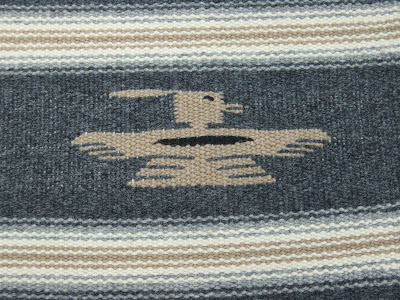
The details of this motif illustrate the finely woven Navajo style.
The most common items produced were blankets, saddle blankets, cloaks and, after trading commenced, rugs. 
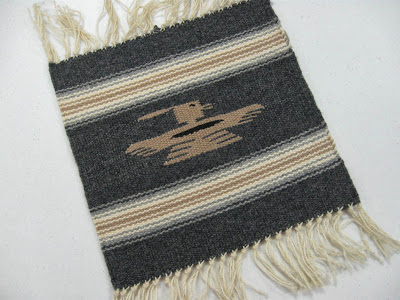
Small Navajo weaving [approximately 12 " square].
The highly-twisted, coarse wool is strong, durable and conducive to these items.
Single ply over-spun yarn used for traditional Navajo weaving.
Using a cotton yarn, Judy Anderson gave a demonstration on warping a half-size Navajo loom. This is a continuous warp process for this weft-faced textile. Shed sticks, battens, beaters and forks are other tools used in the weaving process.
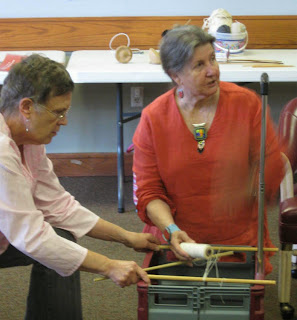
Judy (right) demonstrates warping the loom.
Books can be found on the history, culture and traditions of the Navajo people and their weaving style. Some out-of-print books and resources on Navajo weaving, constructing a loom, tools and the weaving process are still available at your local library, through guilds, used book stores and on-line.

Resources recommended by the program presenters include: Navajo Weaving Way, Navajo and Hopi Weaving Techniques, Working With the Wool, The Magic of Spider Woman, The Woven Spirit of the Southwest, The Weaver's Pathway, and The Book of the Navajo.
Resources and reference books on the Navajo weaving process, tools
and constructing a loom.
Children's books, such as The Spinner's Gift,  Abuela's Weave, and Sunflower's Promise, provide insight into the culture, traditions and myths through stories that both young and young-at-heart will find fascinating and enjoyable.
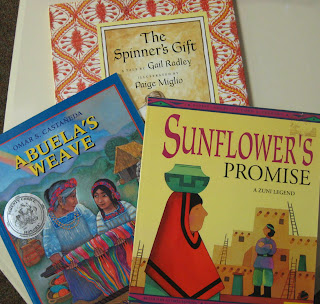
Children's books and stories that illustrate Navajo culture and customs.

Friday, August 9, 2013

Tatting: combining knots and loops

A small length of thread can be transformed into exquisite lace designs by combining a series of knots with strategically-placed loops. A hands-on demonstration of tatting, an early 19th century lacemaking technique, was given at the August meeting of the  Riverbend Fiber Arts Guild.

Marti demonstrates shuttle tatting to Riverbend Fiber Arts guild members.
The picots are used to join motifs.
Long-time tatter, Marti Zoerb, presented the program. Marti—who actually learned the technique from a man—indicated this decorative knot work was derived from the work of sailors and fishermen making fishing nets. As a challenge to each other—and to avert boredom on long sailing and fishing expeditions—fishermen tried to out-do each other by using smaller and smaller ropes and threads to exhibit their knot-making prowess. These intricate motifs were created to impress each other as well as girlfriends and wives on the mainland.

The knots, called double stitches, are similar to the hitches and knots used in macrame. The loops, called picots, are used to join the tatted rings and motifs to each other as well as to create decorative lacy effects. For demonstration purposes, this example shows the tatting stitches in a larger scale.
Teaching example of tatting double stitches.
Marti looks for good quality, smooth, cotton crochet thread (such as DMC Cébelia 100% cotton crochet thread) in size 10, for tatting projects. She prefers using a shuttle for tatting as it accommodates her tighter tension, although the same beautiful effects can be achieved using a tatting needle. The tools and supplies needed for tatting are simple and quite portable. Bring them along on your next fishing—or any traveling—expedition.
Tatting tools and supplies.

Wednesday, April 17, 2013

Crazy Patch: from utilitarian patchwork to embellishment utopia

Crazy patch embroidery.
Patchwork in colonial times was born from necessity. Evidence and documentation on this can be found in journals and diaries from those times. In the late nineteen century, however, this humble piecework was elevated to new heights as women needleworkers became inspired by exhibits of Japanese ceramics at the 1876 Centennial Fair and began incorporating over-the-top stitching and decorative elements on their patchwork. "Oh the crazy quilt mania triumphantly raves, and maid, wife, and widow are bound as its slave..."

At the April guild meeting, members of the Riverbend Fiber Arts Guild had an opportunity to dabble in crazy patch and try their hands at hand embroidery and embellishment.
Martha presents the history of the Crazy Patch and shows her own
patchwork creation using this style of needlework.
The presentation began with a brief history of this quilting and needlework trend. A poem from an issue of The National Stockman and Farmer (circa 1891) was read that relayed men's view of this craze.(They were not happy campers, the poor fellows.) "Your breakfasts are spoiled, and your dinners half-boiled, and your efforts to get a square supper are foiled... by the crazy quilt mania that fiendishly raves, and to which all women are absolute slaves..."

A variety of satins, silks, velvets and other fabrics were available at the meeting for creating a sample crazy patch name tag. Floss, threads, hand embroidery needles, and an embroidery hoop are among the simple tools and supplies needed for this technique.
Choosing fabrics for crazy patch.
Stitch dictionaries and reference books on the topic abound with how-tos and sources for beads, buttons, charms and floss and threads of all kinds. 
Embellishment, embroidery books and stitch dictionaries.
To the dismay of the 19th century gentleman, decorative stitching, embroidery, embellishment and surface design is not likely to diminish any time soon among quilters, sewers and fiber artists. That's what drive-throughs, frozen dinners and microwaves are for.

"But make it she must, she will do it or bust; beg, swap, and buy pieces, or get them on trust. Oh, the crazy quilt mania, may it soon cease to rave in the land of the free and the home of the brave."
Examples of embroidered crazy patch quilt blocks.

Sunday, March 24, 2013

Say "Hello" with Crazy Patch

Hello, my name is... often starts an introduction or is printed on self-stick name tags as a way to begin a conversation and get to know someone. At the April 6 guild meeting, Riverbend Fiber Arts guild members will be using threads, fabrics, fibers and other embellishments to make their guild name badges. 

The program coinciding with this project will focus on the "Crazy Patch" method of combining fabric patchwork with fanciful embroidery embellishments.
Crazy Patch embroidered block.
Come and follow along with the demonstration on Crazy Patch. To make a name tag using this technique, bring the following supplies:

  • 2 or 3 fabric scraps (cottons, silks, blends, etc.)
  • several colors of embroidery thread  or floss that contrasts with your fabrics
  • embroidery needle
  • scissors
Guild members are encouraged to get creative with their name badges—show off a favorite fabric or fiber technique, or venture into something new. A name tag has a small enough canvas to experiment and try something different. Plastic 4"x 3" name tag sleeves will be available for guild members.

Sunday, March 3, 2013

Kumihimo braiding

Kumihimo braiding disk.
Kumihimo, a Japanese form of braid making, was the program at the March meeting of the Riverbend Fiber Arts Guild. These braids can be made with four cords or strands of thread for a basic design, or multiple strands for more complex designs.

Kumi himo is Japanese for "gathered threads." Examples of these decorative and functional cords date back to 1800 BC and can be found in many cultures.

Traditional wooden frames were used by Japanese artisans in a kneeling position. Modernized tools, such as this foam kumihimo disk, are made of lightweight materials and are much more portable and compact.
Basic kumihimo supplies and examples of braided patterns.
Silk threads, with their beautiful reflectance properties are often used for kumihimo, but pearl cotton, yarns, floss, cotton, rayon and metallic threads are other choices that would produce beautiful results.
Pat Keran, the program presenter, explains how to set up the cords
using a North/South/West/East designation.
Today's kumihimo disks have numbers printed on them to facilitate working the proper sequence during the braiding process.
Guild members making kumihimo braids for guild name badges.
Books, references, materials and other how-tos can readily be found on this classic braiding technique.
Examples of books on kuminimo.
The Riverbend Fiber Arts Guild 2013 Challenge, "Recycle—Reuse—Repurpose," was also announced at the March guild meeting.

Friday, February 1, 2013

Alpacas to appear in Super Bowl ad

Leslie Warren, of Rancho Keleje Alpacas in Fillmore, California was asked to provide 20 of her alpacas for the filming of Ford Motor's social media-driven Super Bowl commercial, that will air this Sunday, February 3, 2013.
Alpacas co-star in Super Bowl commercial.
Five Twitter "tweets" were woven into a 60-second spot featuring the Lincoln MKZ, Ford's 2013 redesigned midsize sedan. Comedian Jimmy Fallon put out a Twitter call for the wackiest road trip experiences. Five, from among some 6,117 tweets received, were chosen.

Here are video clips of the filming. To see what role the alpacas play in the commercial, you'll have to watch the game.. or at least the commercials... on Sunday.

Saturday, December 29, 2012

Fleece and flannel warm our furry friends

Animals delight in fleece and flannel blankets.
The Riverbend Fiber Arts Guild will be supporting local animal care facilities and shelters by making fleece and flannel lap blankets at the January 5 guild meeting. The blankets and crate liners provide warmth and comfort to the cats and dogs awaiting adoption into loving homes.

Guild members are asked to bring the following supplies and tools:

  • flannel fabric or flannel pillow cases
  • old towels in any size (beach, bath, hand)
  • scissors for cutting fabric
  • rotary cutters, cutting mats, acrylic rotary rulers
  • sewing machines or sergers and thread 

Fleece fabrics will be provided but donations are gladly accepted. If you would like to pre-cut any fabrics, the animal beds accommodate blankets that are approximately 24" x 36" and 12" x 17" in size.

This guild community service project is an easy and fun activity that everyone can do. Visitors are welcome and donations for the animal center will be accepted. It will all be going to the dogs... and cats!

Wednesday, December 26, 2012

Riverbend Fiber Arts Guild featured on Crochet News Today blog

The Riverbend Fiber Arts Guild was featured in Crochet News Today in its November 13, 2012 blog post. Not a crocheter? Well, don't let the Crochet News Today name fool you as blog editor, Melinda Gorley, offers information and articles about various fiber art disciplines and has included a calendar of events, links to podcasts, guild and club listings, charity organizations, and upcoming fiber and textile art exhibits at museums and galleries on this web site.

Color and texture with knitting.
If you live in the Chattanooga, Tennessee area, and are interested in needle and fiber arts, check out an overview of the activities of the Riverbend Fiber Arts Guild on the About Us page.

Join us in 2013. Enjoy the benefits of annual guild membership for only $15 and treat yourself to a year of fiber art!

Sunday, November 11, 2012

Guild Challenge 2012, fiber art exhibit

Have you ever played, "Animal, Vegetable or Mineral?" The 2012 Guild Challenge for members of the Riverbend Fiber Arts Guild was a take-off on this much-loved guessing game, and the exhibit of Challenge entries was held at the November 3 guild meeting.
Ann Buggey describes the process
and materials used in her entry.
The requirements of the Challenge were to create a free standing, three-dimensional representation of something from nature. Materials used in the piece had to include something from each category—animal, vegetable and mineral—and a photo of the object that inspired the piece was to accompany the entry.

Guild members met the challenge with creative representations of their subjects. At the exhibit, the fiber artists discussed the construction processes and fiber art techniques they employed, and the materials used in their entry that fulfilled the Challenge requirements.

Here are the artists' statements:
Storm Tree by Ann Buggey
"Storm Tree" is made of wool roving, silk ribbon, and copper wire. It sits on a wooden base. The piece was inspired by a gnarled tree growing through a sidewalk in Memphis. No matter how often the tree was trimmed, it grew back more resilient. Its imperfections and the ravages of time and storms, became integral to its beauty.
Storm Tree: wool roving, silk ribbon, copper wire, wooden base.

"Farmer Joe" is a caricature of my older son, Joseph, who has a farm outside of Sewanee, Tennessee. The clothing, hair, etc. is in the style of his dress. He has eggs in one hand and a flower in the other. The armature is wire, he is seated on a piece of wood and the rest is needle felted roving.
Farmer Joe by Peggy Solomon
I like the idea of felting wool, but my hands no longer tolerate wet felting, so I have begun some work with needle felting.
Farmer Joe: needle felting with wool, wire armature, wood base.

"Lady Box Turtle" was inspired by my love for turtles and learning that my Cherokee ancestors were members of the Turtle Tribe. I have been wanting to learn how to sculpt paper clay, so I took this opportunity to try it. This was a fun challenge. 
Lady Box Turtle by Judy Anderson
A covered plastic egg was lined with antique silk. Hand dyed wool was felted for the turtle belly; hand made and dyed silk paper was embroidered with hand dyed silk thread (plates on back). Sculpted paper hands, feet and face; beaded ruffle, necklace and bracelet; crocheted hat.
Lady Box Turtle: plastic egg base, sculpted paper clay, wool, silk paper, beads.
Hand embroidered, felted, beaded and crocheted.
Lady Box Turtle: detail of beaded ruffle, paper sculpted feet and hands.

A ribbon for First Place, two Second Places and Viewers' Choice were awarded. Congratulations to the Challenge participants on their entries.
First Place: Judy Anderson
Second Place: Peggy Solomon
Second Place and Viewers' Choice: Ann Buggey
In appreciation for coordinating this year's Challenge, Pat Keran was presented with the book, "Knit Your Own Dog."
Left: Pat Keran shows the poodle page from the "Knit Your Own Dog" book.
Right: gift wrapping of the Thank You book.

Monday, October 8, 2012

Brainstorming for future programs

The October guild meeting of the Riverbend Fiber Arts Guild was filled with textile examples that stimulated and inspired ideas and suggestions for the upcoming year.

About three years ago, the guild began scheduling time during one of the guild meetings—usually a meeting near the end of the year— to hold an open brainstorming session for all guild members to share their "wish list" or "bucket list" of topics for future programs and workshops.

"This is your guild and we need [everyone's] input," said Guild President, Pat Keran, about generating ideas for programs and workshops for the upcoming 2013 year. "There are no right or wrong ideas in a brainstorming session," said Veronica Hofman-Ortega, who facilitated the session. "Oftentimes, someone else's suggestion will prompt an idea in your mind—something you might not have thought of on your own," she added. "It's all about generating ideas." A whiteboard, set up for capturing suggestions on-the-fly, was filled with over 25 topics by the end of the session. A few more topics were even added after Show and Tell.

Show and Tell provided additional inspiration.
Left: Vicki's woven paper basket with embellishment.
Right: Holly shows her mug wrap, knit in moss stitch. She used a pattern from
the book she won as a door prize at the 2011 Challenge presentation.
This shawl, woven on a triangle loom, will be over dyed in a walnut dye bath.
Triangle loom shawl (left) with edging detail.
A study in weaving huck lace patterns.
A first-time weaver relays her experience with a practice sampler.
Left: A woven scarf using spacers.
Right: A mola sewn to a plain T-shirt makes it quite unique.
Left: Faux batik with crayons. Right: Lace knitting a "Pi" shawl.
Woven scarves: what a difference a technique makes!
Crocheted scarves using interesting trims.
The outcome of this meeting's productive brainstorming session will provide a basis for future guild programs. Summaries and photos of previous year's programs can be found in the Archives: See what we've been doing! section of this web site. You might also enjoy recaps of our Wearable Art Challenge and Fiber Art Tote Bag Challenge. Items that appear at the guild Show and Tell are often the result of a guild program that inspired someone to further study or experiment with a technique or concept. 

Take a look at what the Riverbend Fiber Arts Guild has been up to and let us know what's on your fiber art bucket list. Come out and join us at a meeting. New members are always welcome and bring along your Show and Tell.

2013 Recycling Challenge

The results of the fourth annual Riverbend Fiber Arts Guild Challenge were displayed at the November guild meeting. With the theme of  ...