Friday, September 14, 2012

Paper Basketry

Paper strips were cut using a
pasta cutting machine.
Baskets, boxes, and bowls, whether functional or decorative, can be constructed with a variety of materials. At the September guild meeting of the Riverbend Fiber Arts Guild, paper—a flexible, versatile and readily available material—was the medium of choice for a program on how to make small woven baskets.

Painted paste paper is first cut into strips. A pasta cutting machine, scissors or a rotary cutter and mat can be used for this step. Starting at the bottom of the basket or container, strips are laid out and woven using a basic, plain weave pattern [over-one and under-one]. This weaving pattern is easy enough for beginners yet interesting patterns can be achieved by varying the placement and sequence of the colored strips.

To form the sides of the basket, the paper is slightly folded or crimped and the weaving continues.
Starting with 8 strips, the bottom of the basket is formed.
At the basket's opening, there is a variety of options for finishing: trimming the paper ends with a diagonal cut, curling the ends, and weaving the ends back into the sides of the container, to name a few. A small dot of glue can be used to hold the ends in place, if necessary.
Woven paper baskets.
This is a fun project for novice weavers, children of all ages, and anyone interested in 3-dimensional weaving. Resources such as Making Creative Baskets: Alternative Materials, Simple Techniques, are available for inspiration, instructions and further exploration.
 

Saturday, July 7, 2012

The magic and beauty of Shibori

The program on "Shibori. Making marks with shaped resist dyeing," presented by fiber artist, Veronica Hofman-Ortega, held attendees captivated at the July Riverbend Fiber Arts Guild meeting. Ms. Hofman-Ortega's multimedia presentation and trunk show provided numerous examples of pattern, texture and the visual exuberance that can only be achieved with the shaped resist dye techniques of shibori.
Fiber artist, Veronica Hofman-Ortega, shows her arashi shibori sample
and talks about other examples of shibori patterns and techniques
during her presentation and trunk show.
"Shibori is a timeless and very versatile art form with limitless possibilities," said Veronica. "All aspects of the fabrics, technique, dye sequence as well as the serendipity of the dye bath work in concert to achieve the resulting patterns."

Along with her multimedia presentation, Veronica showed pieces from her wearable art collection, including a shibori wool vest she created based on Rachel Clark's "Picture This" vest pattern, and the mokume shibori jacket and silk dupioni "Power of Panthera Leo" vest that was published with her article, "Compliments of the Dye Pot," in Belle Armoire magazine in 2011.
Veronica displays her shibori wool vest using the "Picture This" vest
pattern
by indie designer, Rachel Clark.
Veronica's collection of shibori artwear is shown at left.
Left: "Power of Panthera Leo" vest, Best of Show at the 2010 Guild Challenge.
Right: Two shibori techniques with appliqué Angelina fibers on a raw silk vest.
Never disappointed with the results of the shibori process, Ms. Hofman-Ortega encourages her audience to "Embrace the serendipity!" and enjoy the magic and organic beauty of shibori.
Mokume stitch resist technique on a raw silk jacket.
More of Veronica's fiber art adventures can be found on her web site, FiberAnticsbyVeronica.com. Veronica offered her recommendations on shibori resources here:


Also visit the World Shibori Network.

-----------------
Show and Tell
Guild members shared their fiber art creations during Show and Tell.
Mary's crochet shawl.
Martha's version of the crochet shawl.
Left: A striped knit shawl. Right: Hannah's crochet necklace.
Knit shawl detail.
Tia shows the loom made by her husband.
Crocheted baby tutu.

Sunday, July 1, 2012

Shibori presentation at July meeting

Fiber artist and guild member, Veronica Hofman-Ortega, will be giving a presentation on Shibori at the July 7 Riverbend Fiber Arts Guild meeting.
Shibori techniques.
Shibori is an ancient resist dying technique that has been practiced in many countries around the globe. It has countless contemporary applications and continues to be inspiring and exciting to fiber artists, dyers, quiltmakers and wearable artists worldwide.

Ms. Hofman-Ortega is also a published writer. Two of her shibori garments were published in her article, "Compliments of the Dye Pot" in the Summer 2011 issue of Belle Armoire magazine. One of the garments, The Power of Panthera Leo, won Best of Show at the Riverbend Fiber Arts 2010 Guild Challenge and was one of the chosen garments to appear on the runway at the 2010 Tennessee Presents Textiles special wearable art exhibit entitled, "The Power of the Pocket." You can read about these and Veronica's other fiber art activities on her blog, FiberAnticsbyVeronica.com.

Come to the July 7 guild meeting and hear about shibori's rich history and magical appeal.

Saturday, June 9, 2012

Making fiber art in 3 dimensions

Does your fiber art need to stand up to be noticed? At the June meeting of the Riverbend Fiber Arts Guild, the program was on making Bases and Armatures for Fiber Art and included many ideas for adding structure and backbone to fiber pieces.
Pat Keran discusses options for creating bases to support 3D fiber art.
The materials that can be used for creating an underlying framework or armature for three dimensional fiber art—wood, wire, masking tape—can easily be found at the local hardware store. Other items such as paper clay, foam, tacky glue and paper maché boxes can be obtained at craft and fabric stores.
The tips and ideas from this program are applicable to this year's Guild Challenge, "Animal, Vegetable or Mineral." 
Paper clay can be molded around a paper maché base
or sculpted to create any shape.

Guild members showed off their latest creations at the meeting during Show and Tell.
Left: a woven jacket made from yarn stash left-overs.
The collar and trim was woven on an inkle loom.
Right: hand made jewelry.
An ethereal SAORI woven wrap.
Hannah explains how to knit with a knitting loom.
Hand knit baby sweater in bright primary and secondary colors.
Left: A thrift store find--woven kimono fabric.
Right: A crocheted hedge hog made with eyelash yarn.

Saturday, June 2, 2012

Fiber Arts at Monteagle Market

Visit the Riverbend Fiber Arts Guild at the 53rd annual Monteagle Mountain Market for Arts and Crafts, July 28-29. Guild members will be giving demonstrations and fabulous fiber art pieces will be available for purchase. Come and see what the guild is all about!


The Monteagle Mountain Market for Arts and Crafts is the oldest re-occurring festivals of the South Cumberland Plateau. Held at Hannah Picket Park, the show is gearing up to be one of the biggest and best markets yet. Many activities are planned for visitors of all ages.

Saturday, May 5, 2012

Colorwork with Tapestry Crochet

Judy Anderson presents
a program on tapestry crochet.
Combine the sculptural qualities of crochet with color work techniques similar to fair isle knitting, and mosaic and figurative designs of tapestry weaving and you have the best of all worlds with tapestry crochet. This was the program topic at the Riverbend Fiber Arts Guild May guild meeting.

Inspired by a workshop with Dr. Carol Ventura, Professor of Art at Tennessee Technological University, guild member Judy Anderson talked about the tapestry crochet technique and showed examples of crocheted pieces done by Dr. Ventura and others.

"Don't throw your Pearls to Swine" (left) and "You will Reap what you Sow,"
tapestry crochet works by Carol Ventura.
Kits, instructions and a demonstration were provided and guild members and guests had an opportunity to work on a small, two-color pouch while learning the technique.
Guild members work on tapestry crochet pieces.
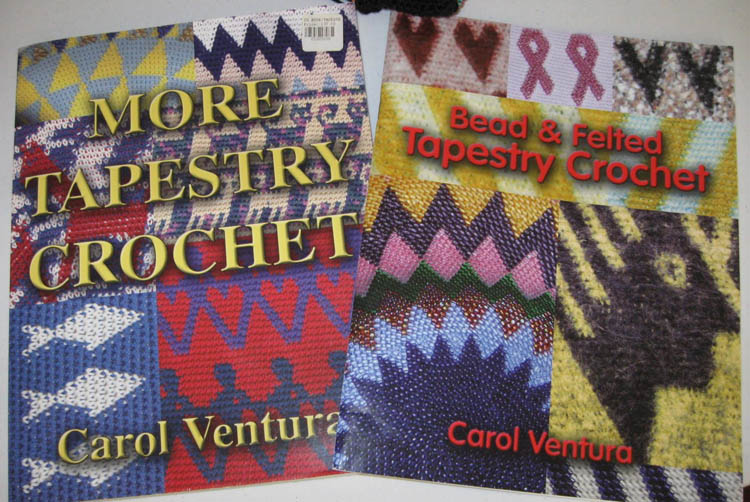
Dr. Ventura, who studies and researches textiles around the world, has written several books on tapestry crochet. You can read more about tapestry crochet on Dr. Ventura's blog, "Tapestry Crochet... the rest of the story."
Books on Tapestry Crochet written by Carol Ventura.
Tapestry crochet bag and cup cozy.


Tuesday, April 24, 2012

A revival of Tapestry Crochet

It's not weaving, it's not canvas work, it's not needlepoint... this mosaic-like colorwork is called tapestry crochet and we'll be wielding our hooks with this technique at the May 5 meeting of the Riverbend Fiber Arts Guild.
Tapestry crochet or mosaic crochet is a form of color crochet.
Tapestry crochet shares attributes of traditional crochet, fair isle and intarsia knitting and has a look similar to weaving. The geometric patterns give a nod to needlepoint and other canvas needle arts.

Tapestry crochet pouch necklace. 
The history of the art form can be seen in decorative crocheted borders from Switzerland, hats from Africa, yarmulkes from Israel and shoulder bags from Guatemala. Today, tapestry crochet can be used to make all kinds of objects—from scarves, hats, garments and jewelry to bowls, baskets, blankets and wall hangings. The resulting fabric can be soft and drapable or firm and rigid, depending on the tension (looseness or tightness) of the stitches. Various yarn weights, fiber types and hook sizes can produce a multitude of results.

At the May 5 guild meeting, a demonstration on making a small pouch necklace will be given. Kits will be available for purchase (yarns only kits and yarns + hook kits), or members can bring the following supplies to make the project.
  • 2 small balls of cotton yarn (worsted or light worsted wt.) in two contrasting colors
  • a size G metal crochet hook
  • scissors
Let's carry on the tradition of this versatile and colorful needle art. Visit the Riverbend Fiber Arts Guild on Saturday, May 5. New members are welcome!

2013 Recycling Challenge

The results of the fourth annual Riverbend Fiber Arts Guild Challenge were displayed at the November guild meeting. With the theme of  ...